
Review snapshot
- Review basis
- Individual 2024 secure-programming review of the public MIT Kerberos 1.16 source and CVE-2018-5709 record; I reviewed a known vulnerability rather than claiming discovery.
- My analysis
- I traced the dump-parser value through parsing, narrowing, allocation and record processing, reviewed the mitigation, and converted the failure into boundary tests and development controls.
- Secure-development focus
- C integer widths
- Parser invariants
- Allocation boundaries
- Patch review
- Static analysis and sanitizers
- Fuzzing and CI
- Principal conclusion
- The defect was an invariant failure across several stages, not an isolated unsafe line. Preventing recurrence required explicit range checks, boundary-focused tests and compiler-assisted verification around untrusted structured input.
Assessment overview
I completed this secure-programming project in February 2024 using the MIT Kerberos 1.16 source tree and the public record for CVE-2018-5709. I was reviewing a known vulnerability, not claiming its original discovery.
The assessment brief placed the work inside a fictional energy-sector company called ScottishGlen. The company relied on Kerberos but did not have a dedicated application-security role. I treated the problem as one a development team would realistically have to own: understand a published defect in software the organisation depended on, explain the code path accurately, identify the condition that allowed the unsafe state, and turn the specific fix into a repeatable secure-development process.
The vulnerable path was not the normal Kerberos ticket exchange. It was the database-dump loader used by administrative tooling. A field from a structured dump file was read into an unsigned integer and later stored in n_key_data, a signed 16-bit member of krb5_db_entry. A value could therefore be accepted by the input parser even though it could not be represented by the destination type.
The significant boundary was INT16_MAX, or 32,767. A value of 32,768 is valid for the %u conversion used by fscanf(), but invalid for the 16-bit signed field that received it. Without a range check before the assignment, the count could change through narrowing. Later allocation and record-processing logic would then operate on a value that no longer meant the same thing as the count supplied by the dump file.
The security problem was not simply that one integer was too large. The parser depended on one invariant across several stages:
declared key-data records in the dump
  = count accepted by the parser
  = count represented by n_key_data
  = number of elements allocated
  = maximum number of records processed
The mitigation rejected u4 when it exceeded INT16_MAX, before it reached the narrower structure member. It then allocated only from the accepted count and checked for allocation failure. That ordering matters. Validation has to happen before conversion, and the same validated value has to drive storage, allocation, loops, and cleanup.
I expanded the review beyond the vulnerable assignment. A robust parser also has to confirm that all expected fields were read, reject malformed input, handle zero deliberately, protect allocation calculations, stop when the file contains fewer records than it declares, and release partially constructed state on every error path.
The development recommendation combined manual review, compiler diagnostics, static analysis, unit tests around integer boundaries, sanitised runtime builds, and structured fuzzing of the database-dump grammar. The point was not to place one scanner into CI and call the problem solved. The controls have different jobs. Review follows types and invariants across files. Compiler warnings catch suspicious conversions. Static analysis finds wider data-flow patterns. Unit tests define exact boundaries. Fuzzing exercises the built parser with malformed but reachable input. Sanitizers make failures visible. Regression tests prevent confirmed defects from returning.
The project gave me a concrete secure-software engineering example rather than a general statement that developers should validate input. The input was syntactically valid. It became unsafe because its range was incompatible with the internal type and because the count controlled later memory operations.
Assessment context
The fictional organisation in the brief operated in the energy sector and faced a credible external threat. It had developers responsible for its applications but no dedicated security function embedded in the software lifecycle. That made the recommendation as important as the code review.
Pointing at one vulnerable assignment is not enough for that situation. The development team needs to know why the assignment is unsafe, how to recognise the same pattern elsewhere, where automated controls can help, and which parts still require engineering judgement.
Kerberos was relevant because it underpins authentication in many Active Directory environments. That did not mean the CVE compromised every Kerberos exchange or every domain using it. The vulnerable component had to be identified precisely. In this case, the defect sat in administrative database tooling that parsed a particular dump format.
That distinction changes the threat model. The input was not an arbitrary network packet reaching the ticket service. It was a structured file processed by a maintenance path. The route to exploitation or failure therefore depends on who can influence the dump, where it is imported, which account runs the operation, and what happens after the count is corrupted.
Administrative tooling still belongs inside the security boundary. Import, backup, migration, restore, and recovery processes often run with privileges and consume data assumed to be trusted. If those assumptions are wrong, a malformed file can reach code paths that are less exposed during normal operation but more privileged when they do run.
Scope and method
My review covered four connected areas:
- the role of secure coding in a development team without a dedicated application-security function;
- the difference between manual review, static analysis, dynamic testing, and fuzzing;
- the source-level path associated with CVE-2018-5709 in the Kerberos 1.16 branch;
- the bounds check and development controls that would prevent the same class of defect.
I used the published CVE record and the historical Kerberos source branch as the basis for the technical analysis. I did not claim to reproduce exploitation, discover a new defect, or assess a current Kerberos release.
The review concentrated on the type conversion and the parser state surrounding it. It was not a complete audit of the Kerberos codebase. Kerberos is large, has several supported formats and administrative paths, and would require a much broader review to make claims about the security of the full project.
I considered code review and fuzzing at a general level during the project. Here I separate the techniques more precisely:
| Technique | Role in this review |
|---|---|
| Manual code review | Follow the value and its meaning across declarations, files, allocation, and processing |
| Compiler diagnostics | Identify implicit narrowing, signedness changes, and suspicious conversions |
| Static analysis | Trace data flow from external input into security-sensitive operations |
| Unit testing | Define valid and invalid values around exact integer boundaries |
| Fuzzing | Execute the parser repeatedly with mutated, structurally reachable dump records |
| Sanitizers | Surface memory, undefined-behaviour, and integer failures during runtime testing |
| Regression testing | Retain every confirmed failure as a permanent test case |
Flawfinder can support static source review by highlighting risky C functions and patterns. It is not itself the fuzzing stage. Fuzzing requires executing the built parser with generated or mutated input and observing the runtime result.
Why the database-dump path mattered
The visible purpose of Kerberos is authentication, but the security of a system is not limited to its main request path. Administrative utilities load databases, migrate formats, recover backups, and rebuild state. They frequently run with privileges and manipulate the same records the live service relies on.
The vulnerable function processed a beta-7 principal record from a dump file. That record included counts describing the data that followed. A count in a parser is not harmless metadata. It can decide:
- how much memory is allocated;
- how many objects are expected;
- how many times a loop executes;
- where the next field begins;
- how much data is copied;
- when the parser considers a record complete.
If the count changes when it crosses a type boundary, the parser can allocate according to one interpretation and process according to another. The immediate defect is numeric, but the effect appears in memory and record handling.
The dump file also had to be treated as untrusted input. An administrator choosing to import a file does not prove that the file is valid. It may have been generated by an older version, transferred incorrectly, altered accidentally, supplied by another system, or deliberately constructed. Privileged maintenance paths need strict parsing because the account running them often has more access than a normal service request.
This is one reason secure development cannot only focus on public API endpoints. File formats, command-line utilities, migration tools, and background jobs are all input boundaries.
Threat model and impact boundaries
The threat model needed to remain tied to the administrative parser rather than the public Kerberos service.
A useful path was:
someone can influence a database dump
  -> a privileged operator or automated process imports it
  -> the beta-7 record reaches process_k5beta7_princ
  -> the key-data count crosses the unchecked type boundary
  -> later processing receives an inconsistent internal value
The first requirement is influence over the file. That influence could come from a deliberately supplied dump, compromise of a system that produces backups, corruption during transfer or storage, or a migration process that trusts data from another environment. The review did not establish which of those conditions existed in a real organisation. It established that the loader had to defend itself even when the file reached it through an administrative workflow.
The second requirement is that the vulnerable format and code path are used. A defect in a database import utility does not mean a remote unauthenticated user can trigger it through the ordinary ticket protocol. That distinction is important when communicating risk. The component may run less frequently, but it may also run with high privilege and operate on authoritative authentication data.
I separated the possible impact into layers:
| Layer | Defensible conclusion from the review |
|---|---|
| Input validation | The parser accepted unsigned values outside the range of the destination field |
| Internal state | The stored count could differ from the value supplied by the file |
| Memory and record handling | Allocation, loops, or parsing could operate from an inconsistent count |
| Service effect | Import could fail, crash, or damage the integrity of the database operation |
| Wider compromise | Dependent on the exact memory behaviour and environment; not demonstrated by this project |
This avoided treating a CVSS score or a vulnerability category as proof of every possible outcome. A narrowing conversion in memory-management code deserves serious attention, but professional reporting still has to distinguish confirmed code behaviour from potential exploitation.
The affected asset also mattered. A Kerberos database is not ordinary application data. It contains authentication principals and key material used by the wider identity system. Even where the immediate outcome is a failed import rather than code execution, corruption or unavailability in that maintenance path can affect recovery, migration, and trust in the database state.
The recommended priority would therefore consider both exploitability and operational consequence. A privileged parser handling authoritative authentication data should be patched and tested even when the route to the malformed file is narrower than an internet-facing request.
Integer overflow and memory safety
Integer overflow is often explained beside buffer overflow because the two can become connected, but they are not the same failure.
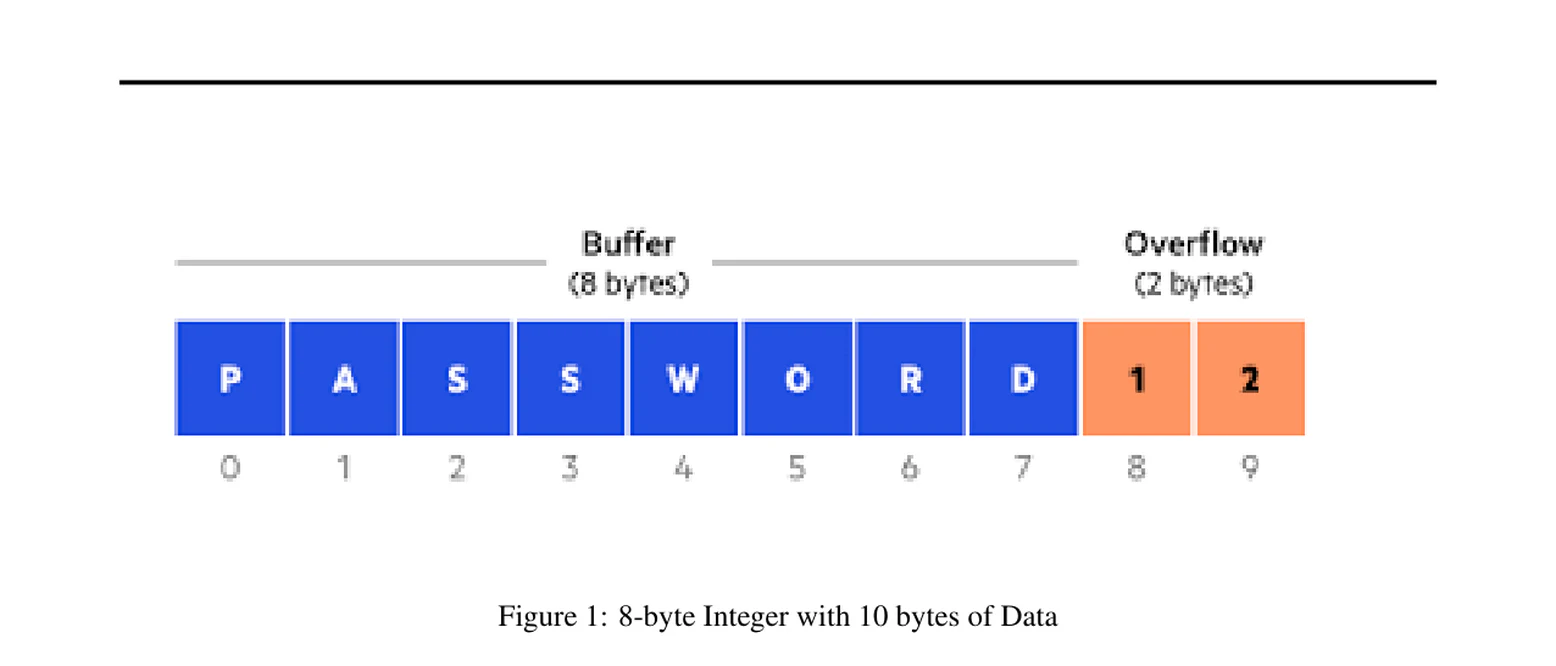
A direct buffer overflow writes beyond the storage reserved for a buffer. An integer overflow or unsafe integer conversion changes a numeric value because the result is outside the representable range of the destination type.
In this case the input was not a long string being copied directly beyond an array. The parser read a number into a type wide enough to hold it. The unsafe state appeared when that number was assigned to a narrower signed field.
For a simplified example:
unsigned int source = 32768;
int16_t destination = source;
The source value is valid for an unsigned integer. It is one greater than the maximum positive value of a signed 16-bit integer. The destination cannot represent the same value. The exact converted result depends on the language rules, implementation, and types involved, but the program can no longer assume that destination equals source.
That matters when the value is a count. A negative, wrapped, or truncated count can reach later code that allocates memory, advances through a file, indexes an array, or decides how many records to process.
The review therefore had to answer more than whether the assignment compiled. It had to answer whether every value accepted by the source type was valid for the destination type and for the operation the destination controlled.
The boundary was clear:
| Value | Valid for unsigned input | Representable by signed 16-bit field | Required result |
|---|---|---|---|
0 |
yes | yes | handle deliberately as zero records |
1 |
yes | yes | continue normally |
32767 |
yes | yes | highest valid positive count |
32768 |
yes | no | reject before conversion |
| maximum unsigned value | yes | no | reject before conversion or allocation |
Input validation is therefore not only checking whether text looks numeric. %u proves that the field can be interpreted as an unsigned value. It does not prove that the value is suitable for every narrower type or later calculation.
The structure member
The source trail began in src/include/kdb.h, where the database-entry structure stored the number of key-data records in n_key_data:
krb5_int16 n_key_data;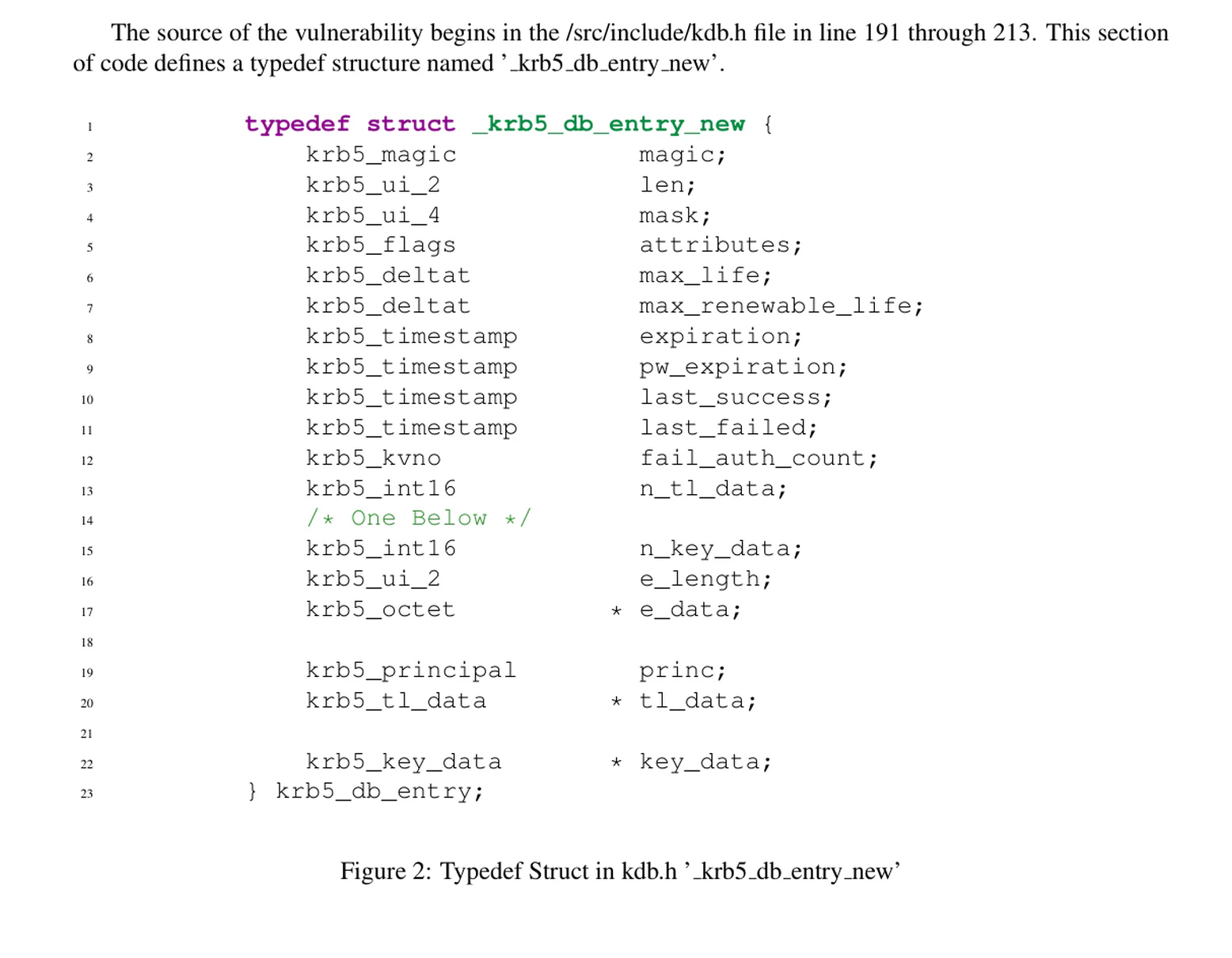
n_key_data as a signed 16-bit value. That type was the destination boundary the dump loader had to respect.The name is important. n_key_data is not simply an identifier. It represents the number of key-data elements associated with the database entry. That connects the field directly to memory allocation and later parsing.
A secure review should treat names like these as signals:
lengthorlen;countorn_*;size;offset;index;capacity;elements.
Any external value entering one of those roles deserves a range and data-flow review. The question is not only which type holds it at one line. The question is every operation it controls after that line.
The structure also included other counts and pointers. That made consistency important. A count and the pointer it describes form one logical object. The count must be valid for the destination type, the allocation must reserve enough elements, the parser must not process more records than were allocated, and cleanup must understand how much state was successfully constructed.
Reading the value from the dump
Inside src/kadmin/dbutil/dump.c, the parser declared several input values as ordinary unsigned integers:
krb5_db_entry *dbentry;
unsigned int u1, u2, u3, u4, u5;

nread = fscanf(
    filep,
    "%u\t%u\t%u\t%u\t%u\t",
    &u1, &u2, &u3, &u4, &u5
);
u4 received the key-data count from the file. The use of %u meant the parser could accept values across the range of the unsigned destination variable. That range was wider than the signed 16-bit field used later.
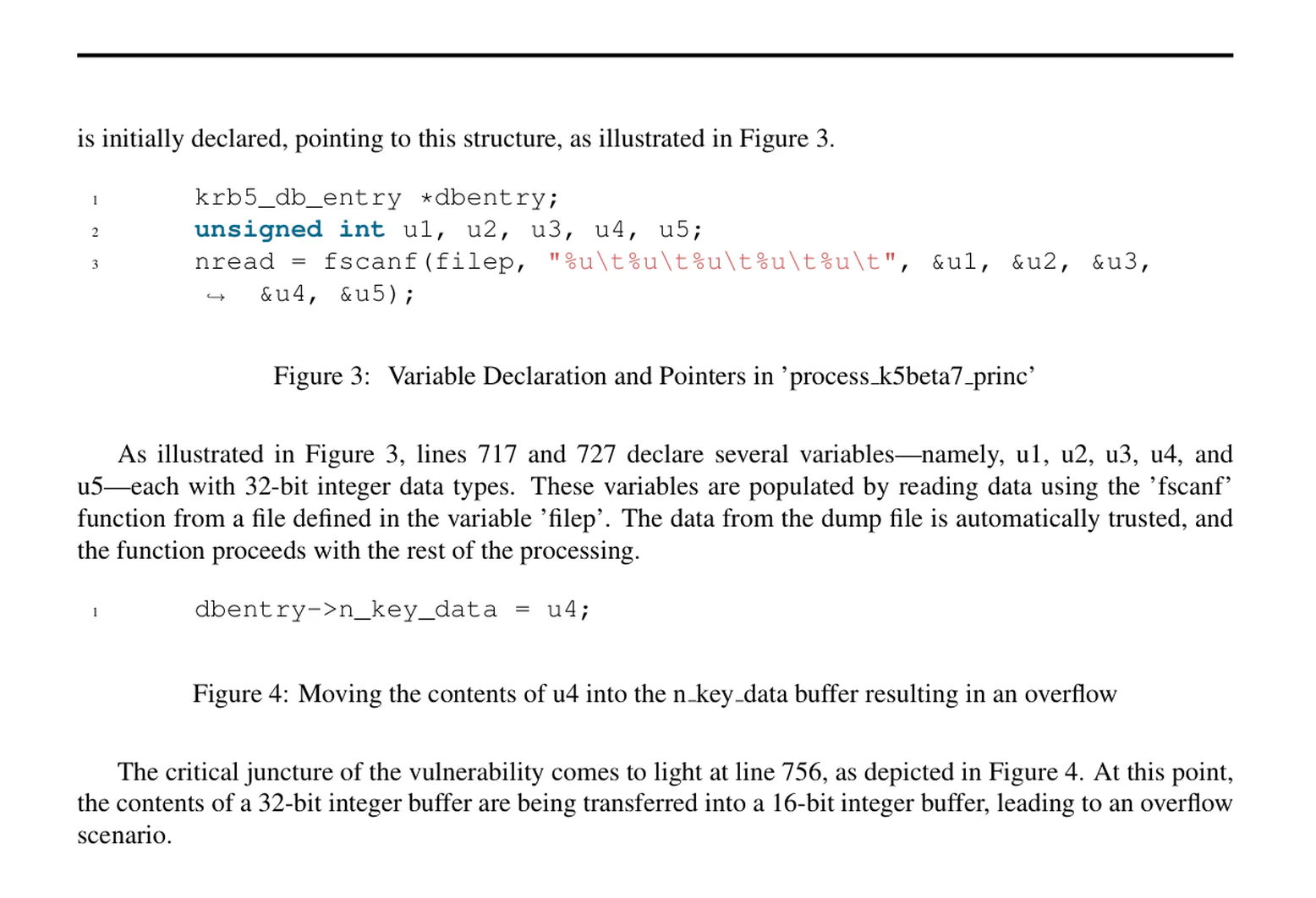
u4 into the narrower n_key_data member without first proving that the value fitted.The critical assignment was:
dbentry->n_key_data = u4;That line is small, but the review depended on information from elsewhere:
- the type of
u4was declared in the parser; - the type of
n_key_datawas declared in the structure header; - the input came from the dump file;
- the value represented a record count;
- later code allocated and processed key-data elements.
A search for obviously unsafe copy functions would not necessarily find this defect. The unsafe state was created by a cross-file type relationship.
This is why manual code review remained useful. The reviewer has to follow meaning as well as syntax. A static analyser may report a narrowing conversion, but an engineer still has to determine whether the conversion is deliberate, whether the accepted range has already been constrained, and what the result controls.
The invariant that failed
I treated the key-data count as one invariant shared across the parser.
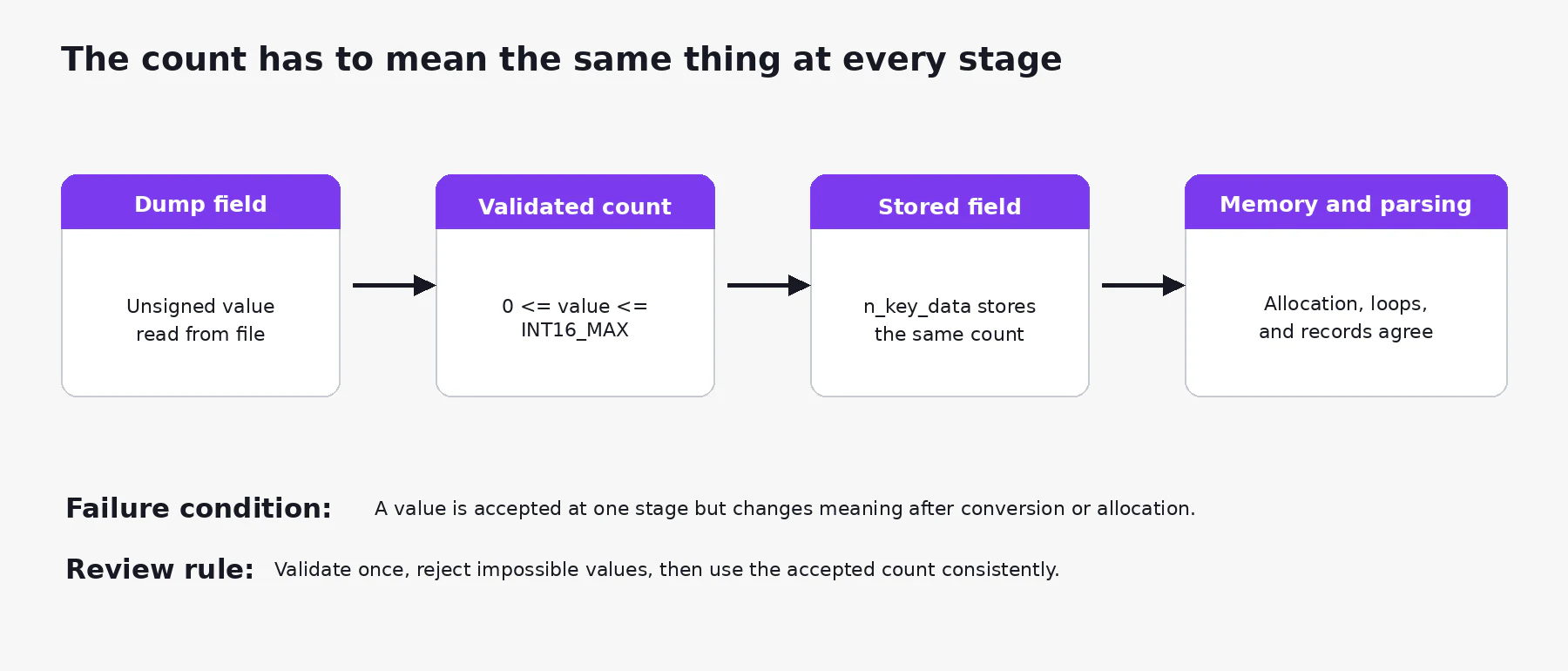
The intended relationship was:
dump says N key-data records
  -> parser accepts N
  -> structure stores N
  -> allocator reserves N elements
  -> parser consumes no more than N records
The unchecked conversion allowed this instead:
dump says N
  -> unsigned input holds N
  -> 16-bit field stores a different value N'
  -> later code operates on N or N' depending on the path
Once there are two interpretations of the same count, the parser’s assumptions break. Possible consequences include:
- an allocation based on an unexpected value;
- a loop bound that does not match the available storage;
- a record count that disagrees with the remaining file content;
- incorrect cleanup of partially initialised elements;
- rejection or corruption of valid database state;
- a crash or other memory-safety failure in a privileged utility.
The exact effect depends on the surrounding code and platform. I did not treat the narrowing assignment alone as proof of remote code execution. The defensible conclusion was that untrusted input could create an invalid internal count and compromise the integrity and safety of later processing.
This invariant-based approach is reusable. The same review applies when:
- a packet length is stored in a smaller field;
- image dimensions are multiplied to calculate allocation size;
- an archive declares more entries than the parser can represent;
- a protocol offset is converted between signed and unsigned types;
- a file count controls both allocation and loop termination;
- a database value is cast before being used as an index.
Reviewing the mitigation
The mitigation rejected values above INT16_MAX before they could be stored in n_key_data:
if (u4 > INT16_MAX) {
    load_err(fname, *linenop, _("invalid key_data size"));
    goto fail;
}

if (u4 && (kp = calloc(u4, sizeof(krb5_key_data))) == NULL)
    goto fail;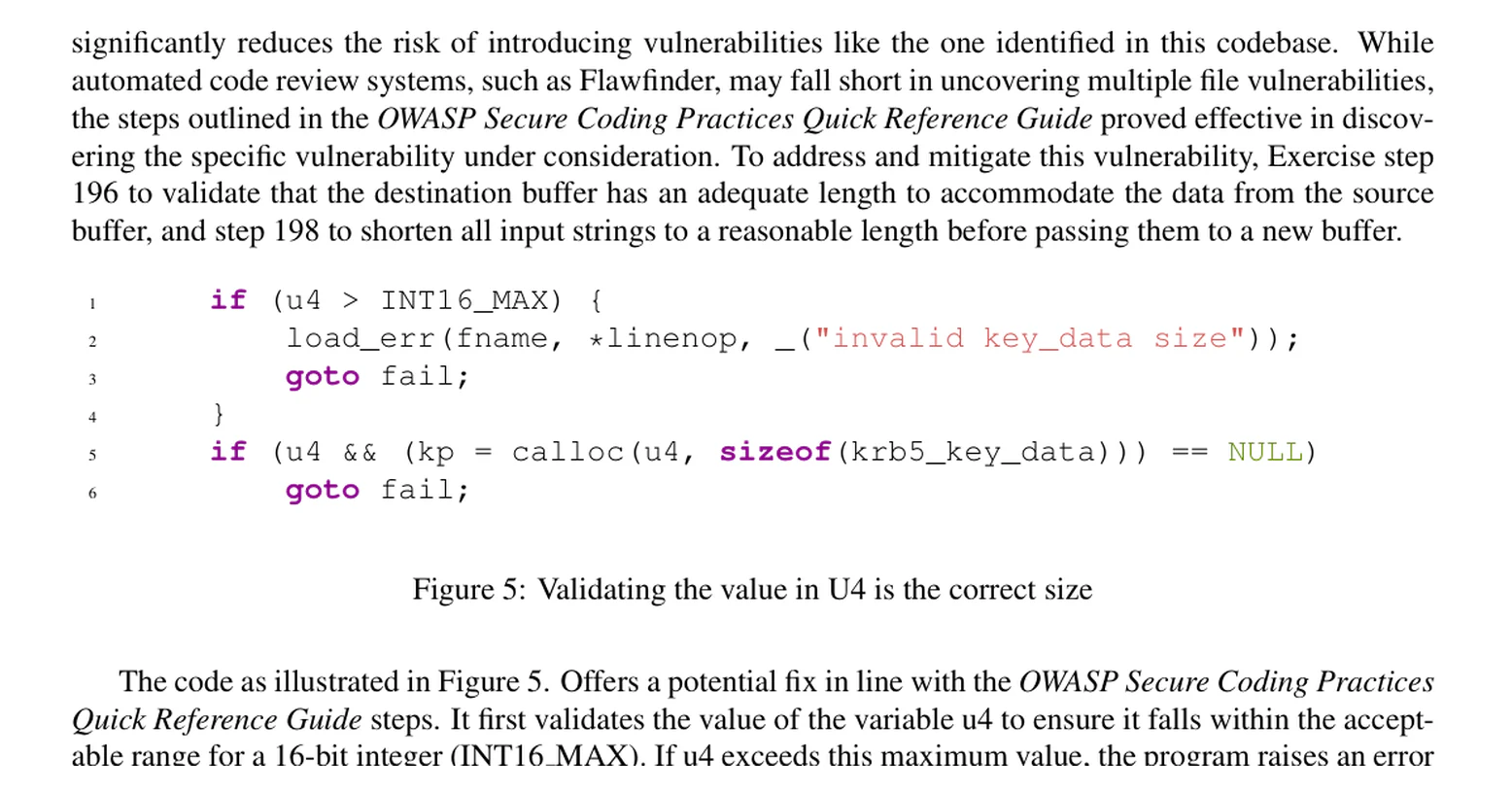
The order is the main point:
- parse the external value into a type capable of representing the input syntax;
- validate it against the semantic and destination limits;
- reject values that cannot be represented safely;
- use the accepted value for allocation and processing;
- handle allocation failure before dereferencing or iterating;
- move through one cleanup path if construction stops part-way through.
The range check restores the relationship between the file and the structure. Every accepted u4 can be represented by n_key_data without changing value.
Rejecting the record is preferable to silently clamping it. If a dump declares 40,000 key-data elements and the loader changes that to 32,767, the imported database no longer represents the input. Continuing would hide corruption and make the later parser state difficult to reason about.
The error also includes the filename and line number. That matters operationally. A parser should fail safely, but it also has to give an administrator enough information to identify the invalid input. The message should describe the rejected field without leaking secrets or leaving the system in a partially imported state.
calloc() does not replace the explicit check. It can allocate an array and initialise it to zero, but it does not know whether the count is valid for n_key_data, whether the count matches the file, or whether the application’s semantic maximum should be lower than the type maximum.
The review should also consider allocation arithmetic. In this case the element count is bounded by INT16_MAX, which substantially limits the multiplication. As a general rule, count * sizeof(element) must be checked for overflow in the allocator’s size type before allocation.
A reusable C pattern is:
if (count > MAX_ALLOWED_COUNT)
    return PARSE_ERROR;

if (count > SIZE_MAX / sizeof(*items))
    return PARSE_ERROR;

items = calloc(count, sizeof(*items));
if (count != 0 && items == NULL)
    return ALLOCATION_ERROR;
The application maximum and the arithmetic maximum are different controls. A value can fit in size_t and still be unreasonable for the format or service.
Wider parser conditions
The published fix addressed the immediate integer boundary, but a secure parser review should continue into the surrounding assumptions.
Field-count validation
fscanf() returns the number of fields successfully converted. The parser has to confirm that the expected number was read before using any of them. A truncated line, missing separator, unexpected sign, or malformed token should not leave a partially populated record continuing through the normal path.
Deliberate zero handling
Zero may be a valid declaration of no key-data records, or it may be invalid for a specific format. The parser needs one deliberate rule. Treating zero as an accidental edge case creates inconsistent allocation and loop behaviour.
Agreement with the remaining file
A valid count is not enough if the file contains fewer records than it declares. The parser has to stop cleanly when it reaches the end of the input or a malformed child record. It must not continue reading uninitialised state or assume the declared count proves that the data exists.
Allocation arithmetic
Every allocation derived from external values needs protection against multiplication and addition overflow. This applies to count * element_size, extra terminators, header sizes, and offsets used to advance through the input.
Consistent loop bounds
The same validated count should control allocation and iteration. Re-reading the raw field, recasting it elsewhere, or using a different member creates another chance for disagreement.
Partial construction and cleanup
If the parser has successfully created some key-data elements before a later record fails, cleanup has to release only the state that was initialised. The failure path should be safe from double free, leaks, or use of uninitialised pointers.
Error handling
The parser should report the location and reason, return a clear failure state, and avoid leaving a partially imported database visible as successful output.
These conditions are part of the same security review because the range check only guarantees that the count can be represented. It does not prove that the file is complete or that every later operation uses the count safely.
Manual review method
I would perform this class of review in a repeatable sequence.
Identify external values
Start with values read from files, sockets, environment variables, command-line arguments, databases, and inter-process messages. Mark every field that represents a length, count, offset, index, or allocation size.
Record source and destination types
For each conversion, document:
- source type and range;
- destination type and range;
- signedness;
- implicit promotions or casts;
- any validation already applied;
- the semantic maximum defined by the format.
Follow the value into sensitive operations
Trace whether the value controls:
- allocation;
- copying;
- pointer arithmetic;
- indexing;
- loop bounds;
- record construction;
- cleanup;
- authorisation or policy decisions.
Define the invariant
Write down what must remain true. In this case, the file count, stored count, allocated count, and processed count had to agree.
Test both sides of the boundary
A review is stronger when the boundary is executable. Test the largest accepted value and the smallest rejected value rather than only an obviously extreme input.
Review the failure path
The rejected value should produce a controlled error, release partial state, avoid continuing with changed data, and leave a reproducible record for debugging.
That approach is more useful than a generic instruction to check buffer sizes. It gives reviewers a specific route through the code and a reason for each check.
Compiler and static-analysis controls
Manual review should not be the only control. C compilers and analysers can make narrowing and signedness issues harder to introduce unnoticed.
Useful compiler diagnostics include warnings for:
- implicit integer conversions;
- sign conversion;
- comparisons between signed and unsigned values;
- overflow in constant expressions;
- suspicious format strings;
- conversion from a wider type into a narrower one.
The exact flags depend on the compiler and project tolerance. Enabling every warning without triage can bury important findings under noise. I would apply stricter conversion warnings first to parsers, memory-management code, cryptographic code, and other security-sensitive components, then expand coverage as the codebase is cleaned.
Static analysis adds interprocedural data flow. A useful rule would track an external numeric value from fscanf() through assignment into a smaller integer and then into allocation or loop control.
The analyser still needs context. Some narrowing conversions are intentional and safe because the value was checked earlier. The review should make that proof visible:
if (source > INT16_MAX)
    return ERROR;

destination = (int16_t)source;
An explicit cast without the preceding check is not proof. It can suppress a warning while preserving the defect.
Static analysis should also look for:
- allocation sizes derived from unchecked input;
- multiplication before allocation;
- loop bounds that use a different variable from the allocator;
- negative values converted to unsigned sizes;
- error paths that leak partially constructed records;
- format-string and destination-type mismatches;
- unchecked return values from parsing functions.
A finding should be linked to the source revision, path, and data flow. That makes it reviewable and prevents the team from treating the scanner output as a list detached from the code.
Fuzzing the dump parser
Random bytes alone are unlikely to reach the vulnerable conversion. A structured parser will usually reject an invalid header or earlier field before it reaches u4. The fuzz target therefore needs enough valid grammar to enter process_k5beta7_princ and reach the key-data count.
I would begin with a minimal valid beta-7 principal record and make the relevant count the primary mutation field.
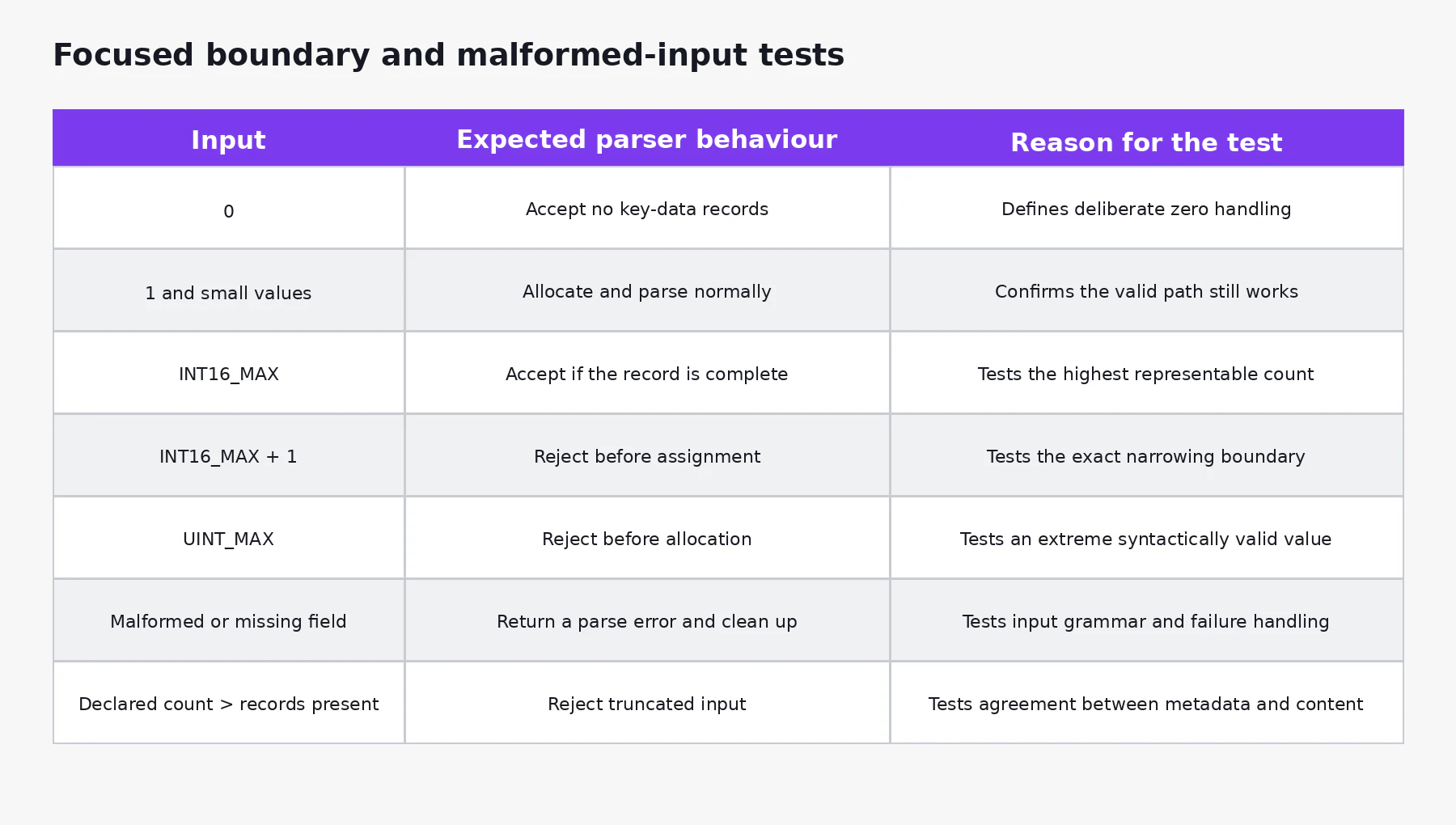
The initial seed corpus should include:
- zero key-data records;
- one valid key-data record;
- several valid records;
- exactly
INT16_MAXwhere practical for a focused unit test; INT16_MAX + 1;- maximum unsigned input;
- a missing field;
- a non-numeric field;
- a truncated record;
- a valid count followed by fewer records than declared.
For full parser fuzzing, a seed containing 32,767 complete child records may be inefficient. The exact boundary can be covered by a focused unit or integration test that reaches the range check, while the fuzzer uses smaller structurally valid records and mutations that exercise count agreement, truncation, separators, and allocation behaviour.
A grammar-aware harness could mutate:
- the count while preserving the other fields;
- separators between numeric fields;
- signs and leading zeros;
- the number of records that follow;
- the length of child fields;
- the end of file at different construction stages;
- duplicate or omitted records;
- values around every related integer boundary.
The harness should call the parser directly where possible rather than launching an entire administrative utility for every input. That improves speed and makes coverage more focused. A separate end-to-end test can retain the real command-line path.
The runtime build should enable the available sanitizers. AddressSanitizer can identify out-of-bounds access and use-after-free. UndefinedBehaviorSanitizer can expose invalid operations and some conversion-related behaviour. Integer sanitizers or compiler instrumentation can add more direct visibility where supported.
A useful fuzzing result contains more than a crash:
- exact input file;
- source revision;
- compiler and sanitizer configuration;
- stack trace;
- code coverage or reached function;
- whether the result reproduces consistently;
- the reduced input after minimisation.
After the issue is fixed, the minimised input becomes a regression test. The value of fuzzing is not the number of crashes reported. It is converting reachable parser failures into reproducible engineering work and permanent coverage.
Placing the controls into CI/CD
The secure-development recommendation combined controls at different speeds and stages.
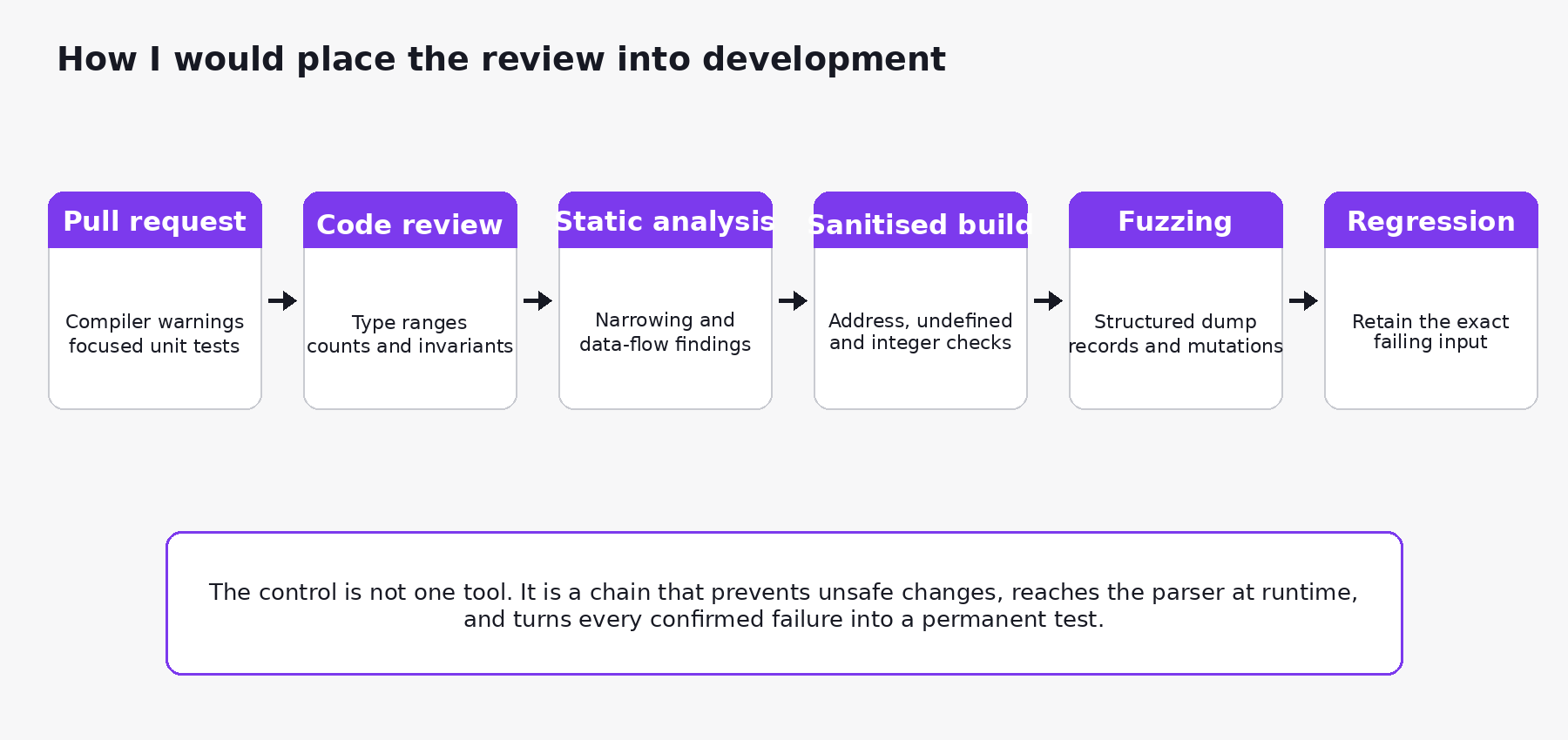
Pull-request checks
Each change should build with the agreed warning policy and run focused unit tests. Security-sensitive parser changes should not merge while introducing new narrowing or signedness warnings.
Review requirements
The reviewer should be shown the input types, destination types, accepted range, and operations controlled by the value. A checklist is useful when it asks concrete questions rather than whether the code is generally secure.
Static analysis
Static analysis can run on changed code in the pull request and more broadly on a scheduled basis. Findings that cross files may need the larger scheduled analysis if the pull-request view lacks enough context.
Sanitised builds
A sanitised build can execute the parser’s unit and integration tests. It will be slower than the normal build but should still run frequently enough that a defect is linked to a recent change.
Fuzzing budgets
A short deterministic fuzzing budget can run in CI for changed parsers. Longer campaigns can run continuously or nightly. New unique failures should create an issue with the input and build metadata rather than only appearing in a dashboard.
Regression retention
Every confirmed boundary failure becomes a test fixture. The test should assert both rejection and safe cleanup. Keeping the input prevents a future refactor from reintroducing the same condition under different code.
The controls can be staged according to cost:
| Stage | Typical controls |
|---|---|
| Every pull request | Compiler warnings, focused unit tests, review checklist |
| Security-sensitive changes | Static analysis, sanitised integration tests, short fuzz run |
| Nightly or continuous | Broader static analysis, long-running fuzz campaigns |
| Release | Full regression corpus, dependency and configuration review |
| After a confirmed defect | Root-cause review, new rule or checklist item, retained failing input |
This avoids presenting security as one final gate before release. The developer receives feedback while the change is still small, and the heavier controls operate without blocking every routine build.
Review checklist for numeric parser input
I would give the development team a focused checklist for counts, lengths, offsets, and sizes:
- Where did the value originate?
- What is the full range of the source type?
- What is the range of every destination type?
- Is the value signed at one stage and unsigned at another?
- Is an implicit conversion changing width or signedness?
- What is the format’s semantic maximum?
- Is the value checked before the first narrowing conversion?
- Can addition or multiplication overflow before allocation?
- Does allocation use the same validated value as the processing loop?
- Does the file contain the number of records it declares?
- What happens at zero?
- What happens at the exact maximum?
- What happens at maximum plus one?
- Is the error path safe after partial construction?
- Is the rejected input represented by a test?
This turns CVE-2018-5709 into a reusable review pattern. The team does not have to remember one Kerberos function. It has to recognise when external numeric data changes type before controlling memory or structure.
Communicating the finding to developers
The finding needed to be written in a form that a developer could act on without reading the whole CVE history.
I would describe it as:
The beta-7 database-dump parser reads the key-data count into an unsigned integer and stores it in a signed 16-bit field without validating the range first. Values above
INT16_MAXcan change during conversion, so allocation and parsing may no longer use the same count represented by the input. Reject the value before assignment and add boundary and malformed-record tests.
That statement identifies the input, conversion, security consequence, correction point, and required evidence. It avoids vague language such as “sanitise the integer” or “increase the buffer”.
The engineering ticket should include:
- the source and destination declarations;
- the exact assignment;
- the accepted and rejected boundary;
- the functions and allocations influenced by the field;
- the expected error behaviour;
- the unit-test and fuzzing inputs required for closure;
- the source revision and affected dump format.
The severity discussion should remain separate from the coding instructions. Developers need an exact defect description. Product and security owners need the operational context: who can supply the dump, which maintenance process imports it, what privilege it runs with, and what recovery or identity functions depend on the result.
Closure should require more than the presence of the INT16_MAX check. The reviewer should verify that the check occurs before every unsafe use, that the accepted value is the one later allocated and processed, and that the failure path leaves no partial database entry visible as successful output.
Engineering recommendations
For the fictional ScottishGlen development team, I would prioritise the recommendations as follows.
Establish ownership
Security remains everyone’s responsibility, but that phrase cannot mean nobody owns the process. One engineer or rotating group should maintain the warning policy, review checklist, analysis configuration, fuzz targets, and triage process. Security specialists can support complex reviews without becoming the only people able to approve safe code.
Start with high-risk parsers
Apply stricter controls first to code that consumes external files, network messages, authentication data, archives, images, and database imports. These areas make the cost of numeric and memory errors higher and provide clearer targets than applying every control to the full codebase immediately.
Make unsafe conversions visible
Enable conversion and signedness diagnostics, document justified suppressions, and require a range check before explicit narrowing of external values.
Standardise allocation helpers
Use shared helpers or reviewed patterns for checked multiplication, bounded counts, zero handling, allocation failure, and cleanup. Repeating low-level arithmetic across the codebase increases the chance of inconsistent checks.
Build realistic parser tests
Tests should use structurally valid examples and exact boundaries. A scanner that never reaches the relevant function gives false confidence even if it processes millions of random inputs.
Preserve defect evidence
Store failing inputs and link them to the source revision and fix. The organisation should be able to reproduce why a check exists years after the original issue was closed.
Measure the process
Useful measures include the time to triage a new sanitizer or fuzzing result, the number of confirmed failures with regression coverage, warning debt in security-sensitive code, and whether repeated defect classes are declining. Counting scanner findings alone rewards noise rather than improved engineering.
Retest and regression criteria
A focused retest of this path should confirm that:
- zero is handled according to the format definition;
- a normal small count still imports correctly;
INT16_MAXreaches the accepted path when the rest of the record is valid;INT16_MAX + 1is rejected before assignment ton_key_data;- maximum unsigned input is rejected before allocation;
- malformed numeric fields return a parser error;
- missing fields do not leave uninitialised values in use;
- a declared count larger than the records present is rejected;
- allocation failure reaches the cleanup path;
- partial key-data construction is released safely;
- sanitised tests complete without memory or undefined-behaviour findings;
- the original failing input remains in the regression corpus.
The retest should also inspect equivalent count fields. Fixing one conversion does not prove that other dump formats or structure members validate their ranges correctly.
Project boundaries and limitations
Known vulnerability review
This was a review of a published CVE and historical source branch. I did not discover CVE-2018-5709 and do not present the work as original vulnerability research.
No exploit reproduction
The project traced the code and mitigation but did not build an exploit or demonstrate code execution. The impact discussion is therefore limited to the invalid count and the memory or data-integrity risks created in later processing.
Historical branch
The case study reflects MIT Kerberos 1.16 and public material reviewed in 2024. It is not a statement about the current Kerberos codebase or supported releases.
Focused source path
I reviewed the relevant structure, dump parser, assignment, allocation, and bounds check. This was not a full audit of all dump formats, database backends, administrative tools, or authentication code.
Proposed testing process
The detailed fuzzing harness, sanitizer configuration, and CI design describe how I would extend the work into an engineering process. I did not implement a complete pipeline or run a long fuzzing campaign during the project.
Simplified introductory figure
The initial overflow diagram illustrates data exceeding a fixed boundary. It is useful for introducing memory-safety consequences, but it is not a literal model of the numeric narrowing in this CVE. The code review distinguishes the two mechanisms.
Organisational scenario
ScottishGlen was a fictional company used by the assessment brief. Recommendations about ownership and rollout were written for that scenario rather than derived from a real development organisation’s staffing, release cadence, or risk appetite.
What I developed through the project
This project developed practical experience in:
- reading a public CVE without overstating what it proves;
- locating a vulnerable path in a large C codebase;
- following a value across header and implementation files;
- reasoning about signedness and integer-width boundaries;
- distinguishing numeric overflow from direct buffer overflow;
- tracing counts into allocation and record processing;
- defining an invariant across parsing stages;
- reviewing error handling and partial cleanup;
- assessing the bounds check rather than only repeating it;
- designing unit tests around exact integer boundaries;
- separating static source scanning from dynamic fuzzing;
- planning a structured parser fuzz target;
- using sanitizers and regression inputs as part of testing;
- placing secure-code controls into a practical CI/CD workflow;
- communicating one technical defect as a reusable development rule.
The most useful part of the work was moving from a vulnerable line to the assumption the parser depended on. The assignment was unsafe because the input and destination had different ranges, but the wider problem was consistency. The file, structure, allocation, loop, and cleanup all had to agree on one count.
It also changed how I think about input validation. A value can be valid text, successfully parsed, and held safely in its first variable while still being unsafe for the next type or calculation. Validation has to be performed against the operation the data is about to control, not only the syntax it arrived in.
The specific fix is a check against INT16_MAX. The reusable engineering work is broader: make conversions visible, define the invariant, test both sides of the boundary, run the real parser under instrumentation, retain every failure, and review all external counts before they control memory.
This page is a secure-code review of historical MIT Kerberos 1.16 source and public CVE material. It does not describe the current security status of Kerberos releases.